

Minobusan in Minobu Town, Yamanashi Prefecture, is home to Minobusan Kuonji Temple, the head temple of the Nichiren-shu sect.Why not stay at a shukubo (temple lodging) and experience a day that begins with morning service?
Four things to do in Minobu

First, apply for an okaicho (public viewing of a Buddhist image)
Upon arrival, first head to Hoonkaku, the main reception. The doors of the Soshido will be opened, allowing you to see the figure of Saint Nichiren, which is usually not visible. No reservation required, approximately 15 minutes.
See how to apply for the Okaijo →
Attend the morning service in the early morning
In the predawn main hall of Kuonji, the chanting of dozens of monks and the sound of large taiko drums echo. Free, no reservation required. You can walk from your shukubo (temple lodging) to attend.
See the flow of the morning service →
View Mt. Fuji from Okunoin
About 7 minutes by ropeway. From Okunoin at the summit, on a clear day, you can see Mt. Fuji and the Fuji River flowing below.
See how to get to Okunoin →
Savor yuba in the temple town
Enjoy local specialties like fresh yuba and Minobu manju. Stroll through the temple town leading to Kuonji and explore its eateries and souvenir shops.
See where to eat and shop →Minobusan in the Future — Nearby Events


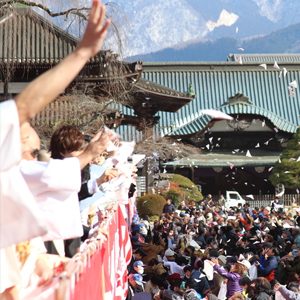

1. First, apply for Okaicho —拝む the figure of Nichiren Shonin at the Soshido Hall
Upon arrival at Mt. Minobu,First, apply for Okaicho at the general reception, "Hoonkaku."
"Okaicho" is the viewing of a statue enshrined within the zushi (miniature shrine) of a hall. At Mt. Minobu, it is the viewing of Nichiren Shonin, who is enshrined in theThe doors of the Great Palace (Daikuuden) in the Soshido (Seishinkaku) are opened, allowing special viewing of the figure and face of Saint Nichiren.Normally, the doors are closed, so only those who apply can participate in this special viewing.
| Item | Details |
|---|---|
| Location | Soshido (Seishinkaku)Google Maps ↗ |
| Application | Reception desk at Honkaku (General Reception)Google Maps ↗ |
| Reception Hours | 5:00 AM - 4:20 PM |
| Duration | Approx. 15 minutes |
| Donation | 2,000 yen per person (1,000 yen for Nichiren-shu temples) |
| Reservation | Not required (There may be times when it is unavailable, such as during memorial services) |
(According to Minobusan Kuonji Official Website "Okaijo, Eko, Kigan, Special Memorial Services" and "Frequently Asked Questions")
Flow of Okaijo
- Go to Honkaku— This is the general reception for Minobusan (Map of Honkaku ↗). It is located right next to the Soshido. You can ascend the Bodai-tei stairs or take the slope elevator to the temple grounds.
- Apply at the counter— State "Okaijo o onegai shimasu" (I would like to request the special viewing) and pay the donation. No reservation is required.
- To Soshido— Follow the guidance and enter the Soshido.
- View the figure— The doors of the Great Palace will open, and you will view the figure of Saint Nichiren (approx. 15 minutes).
- Touring the Temple Grounds— After the Okaijo, let's visit the Main Hall, Five-Storied Pagoda, and Goshinkotsudo (reliquary hall).
Why "First"?
Mount Minobu is where Saint Nichiren spent his later years and where his grave is located.It is recommended to greet the Saint first upon arrival before starting your stay.The reception desk is open until 4:20 PM, so it's a good time to receive it on the afternoon of your arrival day, before checking into your shukubo (temple lodging).
There are times when it cannot be received on days of memorial services or events. For the latest information, please checkOkaijo, Eko, and Kigan (Minobusan Kuonji).
2. Attend the morning service early in the morning
If you stay at Mount Minobu, be sure to wake up early andattend Kuonji's morning service (Asagon). Every morning, dozens of monks gather in the Main Hall of Kuonji to chant sutras.Anyone can attend, and it is free and no reservation is required.
| Item | Content |
|---|---|
| Start Time | 5:30 AM from April to September / 6:00 AM from October to March |
| Location | Minobusan Kuonji Main HallGoogle Maps ↗ |
| Duration | Approximately 45-60 minutes |
| Fee/Reservation | Free, no reservation required |
| Route from shukubo | Approximately 5 minutes walk from Matsui-bo and Habanobo, approximately 12 minutes walk from Shimanobo |


Flow of the morning service
- The Great Bell Rings (approx. 30 minutes before start)— The great bell rings, announcing the morning throughout the temple grounds. This bell was cast in 1624. Monks grasp a rope and lean back so far their bodies are parallel to the ground to strike it. You can hear it even from your shukubo (temple lodging), so use it as a signal to get ready and head to the main hall.
- Enter the Main Hall and Sit— Enter through the front entrance and sit in an available spot in front of the altar. In addition to seiza (kneeling) and cross-legged sitting, chairs are also provided.
- Sutra Chanting and Great Drum— Dozens of monks begin chanting sutras. The sound of the great drum, played by two monks, is powerful enough to resonate deep within your body. The chanting begins with the Kaikyoge, then reads the Hoben-bon and Nyorai Juryo-bon chapters of the Lotus Sutra, and concludes by chanting the Odaimoku, "Namu Myoho Renge Kyo."
- Prayer and Dharma Talk— After a prayer and Dharma talk by the officiant, the service concludes with the chanting of the Shiguseigan (Four Universal Vows).
- After the Service— You can also visit the adjacent Soshido (Founder's Hall). It's also recommended to walk through the temple grounds in the quiet morning, visiting the Bodai-tei (Stairway to Enlightenment) and the Five-Storied Pagoda.
(Times and flow are based on the Japan Tourism Agency's "Multilingual Commentary Database of Regional Tourism Resources" and the official website of Minobusan Kuonji Temple)
Tips for Attending
- Attire— The main hall before dawn can be chilly even in summer. It's a good idea to bring an extra layer. Since you'll be sitting for a long time, comfortable clothing that allows for movement is recommended.
- Seating— If you have difficulty with seiza, you can use a chair. First-timers might want to observe from the back seats.
- Manners— Please refrain from talking during the service and attend quietly. For photography, please follow the local guidelines.
- Even First-Timers Are Welcome— Even if you can't read the sutras, you can participate just by sitting and listening. Some shukubo will guide you to the main hall.
Attending is Possible Precisely Because You Stay at a Shukubo
Since the morning service begins at dawn, it's not easy to attend on a day trip.If you stay at a shukubo on Minobusan, you can hear the great bell and then walk to the main hall.Some shukubo also offer services or Dharma talks in their own main halls in the evening.
Times may vary depending on the season or event days. For the latest information, please checkMinobusan Kuonji Temple's "Service Times".
3. View Mt. Fuji from Okunoin — Take the Ropeway to the Summit of Minobusan
At the summit of Minobusan, there isOkunoin ShishinkakuIt is said to be the place where Saint Nichiren prayed, thinking of his parents in his hometown.
To reach the summit,Minobusan Ropewaycan be taken. With an elevation difference of 763 meters, it takes about 7 minutes to reach the summit. On clear days, you can see Mt. Fuji, Suruga Bay, and the Yatsugatake Mountains from the summit. The summit station has a restaurant, "Minobuan," and a shop.
Recommended Time— Mt. Fuji is best seen on clear, sunny mornings when the air is crisp. In winter, you can see Mt. Fuji covered in snow. Attending the morning service, having breakfast, and then taking the ropeway up allows you to make the most of your day.

- Operating hours and fares vary by season.Minobusan Ropeway Official Websitefor details.
- The station at the foot of the mountain is near the grounds of Kuonji Temple.Map of the Ropeway Station ↗
4. Savor Yuba in the Monzen-machi — Eating and Shopping in Minobu
The street from Kuonji Temple's Sōmon (main gate) to Sanmon (three-gate) isMonzen-machi (temple town)It is lined with restaurants and souvenir shops for worshipers.
Local specialties: yuba and Minobu manju


- Yuba— A representative specialty of Minobu. In addition to being an item in shojin ryori (Buddhist vegetarian cuisine), it can also be enjoyed in dishes like yuba-don.
- Minobu Manju— Available at confectionery shops in Monzen-machi and in front of Minobu Station. Popular as a souvenir.
Dining — From local cuisine restaurants to cafes and sweet shops


In Monzen-machi and at the ropeway's summit, you'll findrestaurants serving local dishes like hoto and shiitake-don, unaju restaurants, cafes in old folk houses, and sweet shops— a collection of establishments with different atmospheres. Many shops in town operate mainly during lunchtime, so we recommend having breakfast and dinner at your shukubo (temple lodging) and lunch at a shop in town.
See 9 dining spots in photos (cuisine, atmosphere, business hours, prices)
In addition, if you want to taste Minobu's famous yuba, there is "Seiryu (Minobu Yuba no Sato)" which is attached to a yuba factory.Map ↗
Business days and hours vary by store and may change. Please check with each store before visiting.
As a setting for the anime "Yuru Camp△"
Minobu Town is also known as a town with many locations that appear in the anime "Yuru Camp△". Some people visit specifically for Minobu Station and Minobu Manju, which appear in the work.
How to visit Minobusan Kuonji — The 287 steps of Bodai-tei and the inclined elevator

Nichiren Shonin entered the mountain in 1274 during the Kamakura period, and in 1281, it was named "Minobusan Myohokkein Kuonji." Around the temple grounds, there are shukubo (temple lodging) for worshippers and a monzenmachi (temple town).
The entrance to the temple isthe Sanmon gate.After passing through the Sanmon, the stone steps leading straight up to the main hall,Bodai-tei,appear. There are 287 steps, divided into 7 sections, named after the 7 characters of "Namu Myoho Renge Kyo." Since these are steep stone steps, please wear comfortable shoes.


If you wish to ascend without using the stone steps, you can use the inclined elevator.It goes up from the "Seishin Parking Lot" on the west side to the side of the main hall. Usage is free (there is a donation box).
The center of the temple grounds is at the top of the stone steps.
- Main Hall— A large hall rebuilt in 1985 (32 meters wide, 51 meters deep).
- Soshido— A hall dedicated to Nichiren Shonin. It was relocated and rebuilt in 1881.
- Five-story Pagoda— After being burned down in a great fire in 1875, it was rebuilt in 2009, 134 years later.
- Goshinkotsudo— A white octagonal hall enshrining the remains of Nichiren Shonin.
- Gobyosho— The tomb of Nichiren Shonin and the site of the hermitage where he lived. It is about a 15-minute walk from the main hall along the Nishitani Sando path.

Regarding the morning serviceSee "2. Participate in the morning service early in the morning" above.Please see.Goshuinare available at the general reception desk, "Ho-onkaku." The reception hours are from 5:00 AM to 4:20 PM (according to the Minobusan Kuonji official website).
For the latest information, please check theMinobusan Kuonji official website.Map of Kuonji ↗
Mt. Shichimen — Sunrise over Mt. Fuji


Mt. Shichimenis a mountain with an elevation of 1,982 meters, towering west of Mt. Minobu. Near the summit isKeishin-in, which enshrines Shichimen Daimyojin, the guardian deity of Mt. Minobu.
- The trailhead for the omotesando (main approach) is Hagoromo in Hayakawa Town. It takes4 to 5 hoursto reach Keishin-in (according to the Minobusan Kuonji official website). Please come prepared with appropriate hiking attire and equipment.
- Keishin-in also offers accommodation (reservations by phone are required).
- Mt. Shichimen is located almost directly west of Mt. Fuji.Around the spring and autumn equinoxes, you can see "Diamond Fuji", where the sun rises directly from the summit of Mt. Fuji.
Many people stay at a shukubo (temple lodging) on Mt. Minobu to rest, then head to the trailhead early the next morning. For detailed hiking information, please see theMt. Shichimen Pilgrimage Guide (Minobusan Kuonji).
Mt. Minobu in Four Seasons — Best Time for Weeping Cherries and Autumn Leaves
Spring — 400-year-old weeping cherry trees (late March to early April annually)

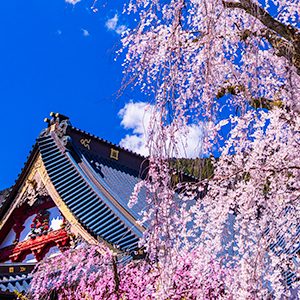
On the grounds of Kuonji, there aretwo weeping cherry trees over 400 years old. One is in front of the Soshido, and the other is in front of the Kyakuden. The best time to see them is from late March to early April annually (according to Fuji-no-Kuni Yamanashi Tourism Net).
During cherry blossom season, traffic regulations may be in effect on surrounding roads. Staying at a shukubo allows you to walk the temple grounds early in the morning before traffic congestion begins.
Autumn — Autumn leaves (typically mid to late November)
The autumn leaves of Mt. Minobu are typically at their best from mid to late November. The areas around Sanmon Gate, the Gobyosho (mausoleum), and the mountainside viewed from the ropeway are dyed in red and yellow. Thephoto at the beginningof this page shows the entrance to Bodai-tei (Bodhi Stairway) colored with autumn leaves.
Winter — Quiet mountain grounds
Winter is the quietest season on the mountain, with fewer visitors. On clear days, you can see snow-capped Mt. Fuji from Okunoin (3. View of Mt. Fuji from Okunoin).
Annual Events
Minobusan Kuonji Temple holds events throughout the year, such as Oeshiki (Mando Gyoretsu procession) in October, Setsubun-e in February, Senbu-e in May, and Kaiso-e in June. The dates and distance from the shukubo (temple lodging) are summarized inMinobusan/Minobu Town Events.
1-night, 2-day model course staying at a shukubo
Here is an example of how to enjoy Mt. Minobu, made possible by staying at a shukubo.
Day 1
- Afternoon— Take a bus from Minobu Station to Mt. Minobu.First, apply for Okaijo at Hoonkaku and pay respects to the image of Nichiren Shonin at Soshido(reception until 4:20 PM).
- Evening— Walk through the temple town, browse souvenir shops, then check into your shukubo.
- Night— Spend time at the shukubo. The mountain grounds are quiet at night.
Day 2
- Early morning— Attend the morning service at Kuonji Temple's main hall (from around 5:30 AM; from around 6:00 AM from October to March).
- Morning— Walk through the less crowded temple grounds, visiting Bodai-tei, the Five-Story Pagoda, and Gobyosho.
- Morning— Take the ropeway to Okunoin at the summit. If it's clear, enjoy the view of Mt. Fuji.
- Lunch— Yuba cuisine lunch at the mountaintop restaurant or in the temple town.
For those confident in their physical strength, there is also a course to head to Mt. Shichimen in the early morning of the second day, stay at Keishinin, and worship the sunrise.
Extend your trip to the surrounding areas
- Shimobe Hot Spring Village— A hot spring resort in Minobu Town.Map ↗
- Lake Motosu— One of the Fuji Five Lakes, located in Minobu Town.Map ↗
- Minobu Yuba no Sato— A facility for yuba production, sales, and dining.Map ↗
- Fujikawa Craft Park— A large park in Minobu Town.Map ↗
Tourist information for the entire town is also available onMinobu Town Tourist Information Site "Minolove".
Access
- Train/Bus— Get off at Minobu Station on the JR Minobu Line, then take the local bus "for Minobusan" to the final stop "Minobusan" (approx. 15 minutes). There are also highway buses from Shinjuku, Shizuoka, and Kofu.
- Car— Head to Minobusan from the Minobusan IC on the Chubu Odan Expressway. On holidays during cherry blossom and autumn foliage seasons, roads may be congested and traffic regulations may be in place.
Parking lots include "Seishin Parking" (paid, with a sloping elevator boarding point) on the west side of Kuonji, and "Kanromonshita Parking" (free) on the east side (according to the official Minobusan Kuonji website).
Stay at a shukubo in Minobusan
OTERA STAY offers three shukubo (temple lodging) in Minobusan. From any shukubo, you can walk to attend the morning service at Kuonji.

Temple Hotel Shimanobo
Minobu Town, Minamikoma District, Yamanashi Prefecture
A shukubo with the oldest history in Minobusan, founded 750 years ago

Temple Hotel Matsui-bo
Minobu-cho, Minamikoma-gun, Yamanashi Prefecture
A shukubo (temple lodging) with a direct view of Kuonji Temple's Sanmon Gate

Temple Hotel Habanobo
Minobu-cho, Minamikoma-gun, Yamanashi Prefecture
A shukubo with a view of Mt. Shichimen
The information provided is current as of September 28, 2026. Business hours, fees, and event schedules may change. Please check each official website before visiting.