![[Official] Zenkoji Temple | Oterastay in Hida Takayama, Gifu](https://oterastay.com/zenkoji/wp-content/uploads/2021/03/スクリーンショット-2021-03-05-9_Fotor.png)
About Takayama Zenkoji
Takayama Zenkoji Temple is a Jodo sect temple open to visitors regardless of nationality, religion, or gender.
This temple is a branch temple of Shinshu Zenkoji in Nagano Prefecture and enshrines the Amida Nyorai (Zenkoji Nyorai) in the Ikkō Sanzon style. Currently, approximately 400 temples in Japan enshrine the Zenkoji Nyorai, of which about 100 officially bear “Zenkoji” in their temple name. Among these, only about 20 temples have been granted the title of “Branch Temple” by Shinshu Zenkoji. In Gifu Prefecture, Takayama Zenkoji is the sole temple holding this distinction. Additionally, like Shinshu Zenkoji, it features an underground Okaidan Meguri.
Since its founding, this temple has provided lodging quarters for pilgrims traveling from afar. Today, it has become an internationally diverse lodging where foreign visitors from around the world gathering in Takayama stay, with over 95% of guests being foreign nationals. The kitchen is also open for guests to use freely.
Features of Zenkoji
1. Shinshu Zenkoji Branch Temple
Only about 20 temples have been granted the title of branch temple by Shinshu Zenkoji, and Takayama Zenkoji is One of them.
2. A Pure Land-style garden offering respite from the clamor
It depicts the path to rebirth in the Pure Land by recreating the “Two Rivers and White Path” and chanting the Buddha’s name while crossing the stone bridge.
3. The Kaidan-Meguri
An immersive experience into the world of Buddha, feeling one’s way through the darkness. A practice to receive the promise of rebirth in the Pure Land.
The Gohonzon (Amida Nyorai with One Light and Three Attendants)
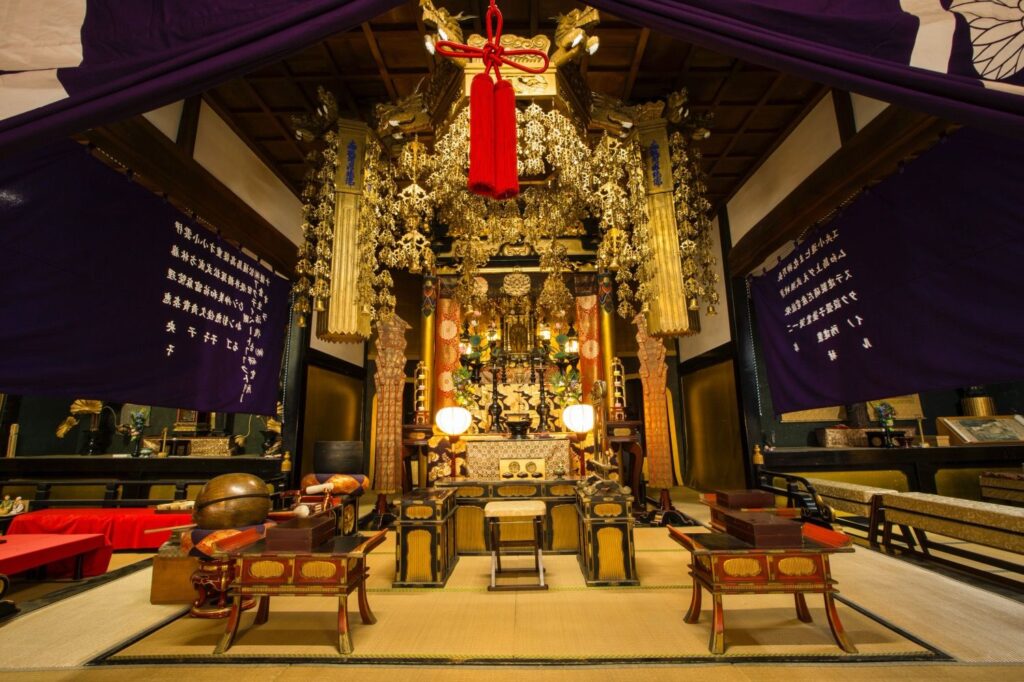
The Gohonzon of Zenkoji Temple in Takayama is a statue of Amida Nyorai in the Ikkō Sanzon style. It depicts the three venerable figures—Amida Nyorai in the center, Kannon Bosatsu to the right, and Seishi Bosatsu to the left—standing together within a single halo. Furthermore, the Gohonzon is an absolutely secret Buddha, so its form cannot be seen.
According to the “Origin of Zenkoji Temple” from Shinshu Zenkoji, the Zenkoji Buddha is said to have first appeared in India during the lifetime of Buddha. It is then said to have been brought to Kudara (Korea), and presented to Japan when Buddhism was introduced in the 13th year of Emperor Kinmei’s reign (552 AD). It is also said to be Japan’s oldest Buddhist statue.
The Gohonzon has been revered since ancient times as the “Living Buddha,” possessing the warmth of human skin, conversing with people, and emitting the light of wisdom from the white hair between its eyebrows. At Horyuji Temple in Nara, the “ Zenkoji Nyorai Gosho Box” still exists today; it is a document box containing letters exchanged between Shotoku Taishi and the Zenkoji Nyorai. In this way, the Buddha has gathered devotion as a deity who interacts with people.
The mudras of the Gohonzon are distinctive. In the center, Amida Buddha’s mudra is the Fearlessness Mudra (Semui-in) with the right palm open and facing us, while the left hand is lowered in the Sword Mudra (Tō-in), with the index and middle fingers extended and the other fingers bent. This mudra is characteristic of Buddhist statues from the Asuka and Hakuhō periods, exemplified by the Shaka Sanzon statues in Horyuji Temple’s Golden Hall.
The mudras of the bodhisattvas on either side are called the Bonkyo-in (Buddhist Scripture Chest Mudra). They form a rare mudra by placing the right palm over the left palm in front of the chest. It is said that within these palms lies a medicine chest containing a pearl. Furthermore, the triad stands upon a mortar-shaped lotus pedestal formed by overlapping stamens left after the petals have fallen.
A single-light triad of Amida Nyorai statues possessing all these characteristics is commonly referred to as the Zenkoji-style Amida Triad, or Zenkoji Nyorai.
Tokuhon Syo-nin – Kigou
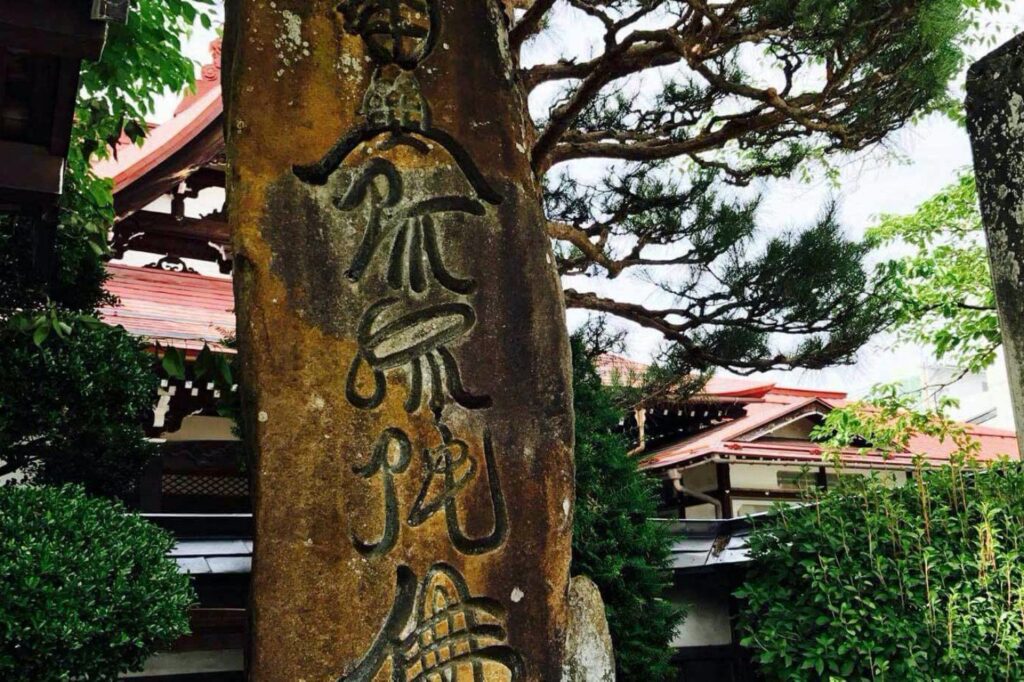
Takayama Zenkoji Temple is located on National Route 158. Beside the temple gate facing the highway stands a large stone monument inscribed with the words “Namu Amida Butsu” in a distinctive calligraphic style. The inscription was penned by the venerable monk Tokuhon Shōnin from Kii Province (Wakayama Prefecture).
The History Leading to the Erection of the Monument and the Relocation of Zenkoji Temple
Tokuhon Shonin visited Takayama from Shinano Province (Nagano Prefecture) in the 13th year of the Bunka era (1797) during the Edo period.
From July 14th for three days, Daioji in Takayama invited Tokuhon Shonin and set up a raised platform on the front veranda of the main hall. So many listeners gathered that he gave Dharma talks three times a day—morning, noon, and evening. To commemorate his visit, Tokuhon Shonin wrote the sacred name “Namu Amida Butsu” for Daioji. It was decided to erect a stone pagoda engraved with this name.
To have Tokuhon Shonin perform the calligraphy and the eye-opening ceremony, a large stone was hauled down from Mount Matsukura to the foot of Daioji Temple. This involved a massive communal effort where the people pulled the stone together.
Additionally, Daioji Temple planned to erect a stone stupa bearing the name inscribed by Tokuhon Shonin at the execution ground of the Kiryu Man’en-kō (a religious association), equivalent to a modern execution site. They petitioned the district magistrate’s office, but in January of Bunsei 2 (1803), the petition was rejected with the instruction “It shall not be permitted” from the Shogunate’s Accounting Office.
The reason given for the rejection was that, since the Jōdo sect was the official sect of the shogunate, it would be better to refrain from placing a stone stupa inscribed with the Nembutsu (Namu Amida Butsu) at the execution ground. Subsequently, in February 1805 (Bunsei 4), Daioji Temple submitted another petition. Permission was granted on the condition that the stupa be erected outside the Man’en-kō execution ground, and so the stupa was built.
However, about 120 years later, during the Showa era, road expansion made relocation necessary. It was suggested that returning it to a Jōdo sect temple would be appropriate. This connection led to its transfer to Takayama Zenkoji Temple, where it remains today.
Garden
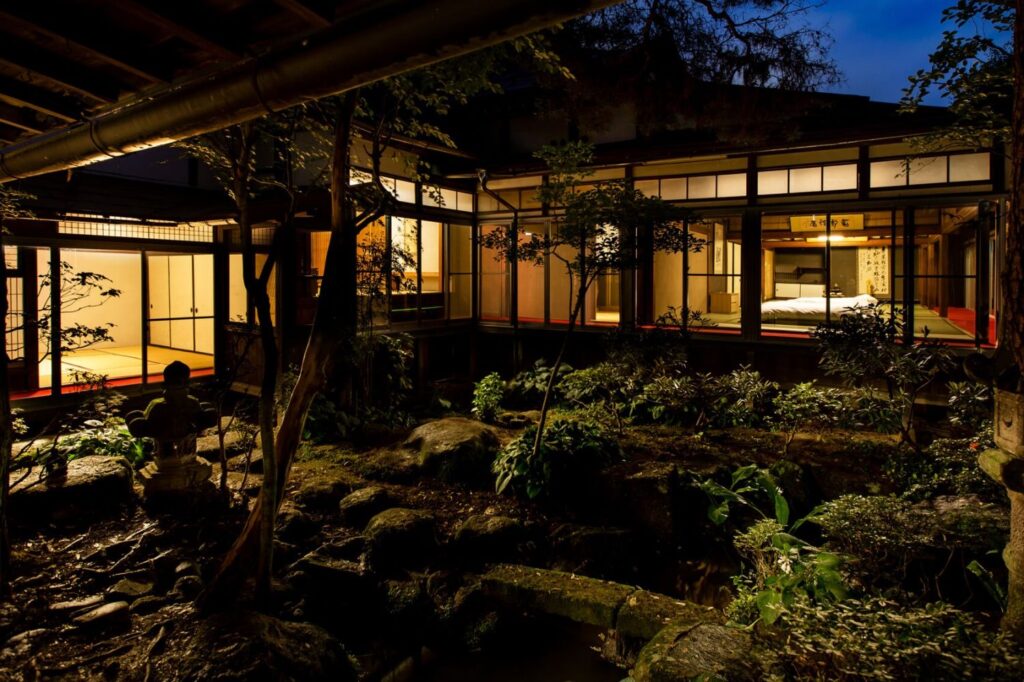
Behind the main hall lies a garden recreating the “Two Rivers and the White Path” parable, a unique teaching of the Jodo sect.
The “White Path Between Two Rivers” is a metaphor for the faith that, between this world and the Pure Land of Ultimate Bliss, lie a raging river of fire and a torrential river of water that humans cannot cross. However, by believing in and chanting “Namu Amida Butsu,” a single white path appears, allowing one to reach the Pure Land by traversing it. This teaching was primarily illustrated in paintings and hanging scrolls.
The garden at Zenkoji Temple in Takayama follows this faith, expressing that crossing the stone bridge over the pond while chanting the nembutsu leads to rebirth in the Pure Land.
War Memorial
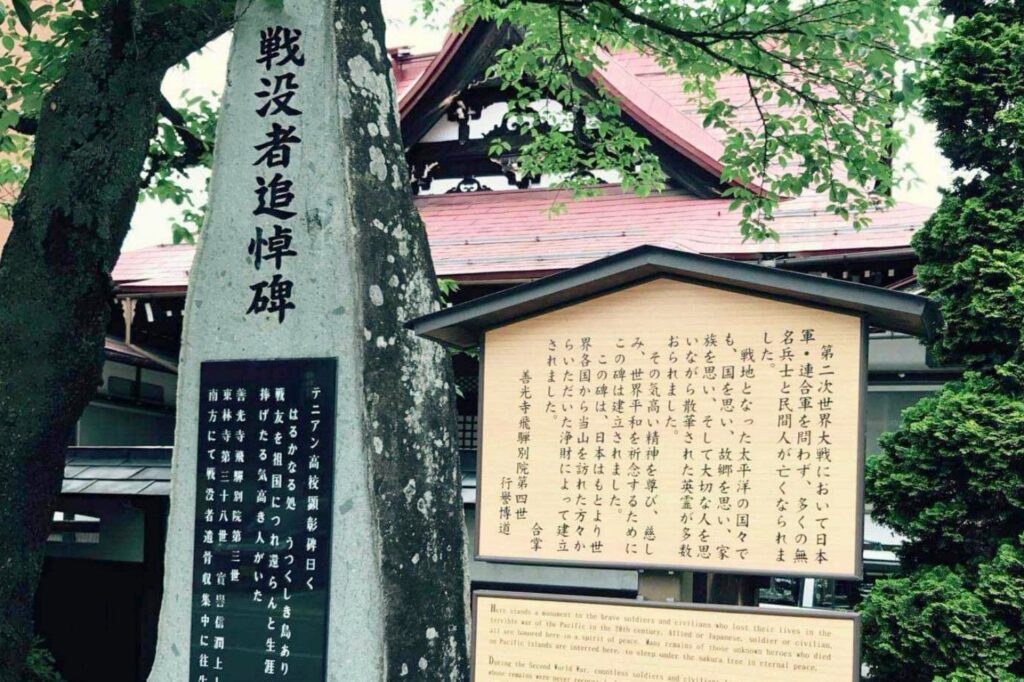
During the Pacific Theater of the Second World War, countless lives were lost, regardless of military or civilian status or nationality.
The third abbot, Shinjun, himself served as a naval airman during the war and lost many comrades on the battlefield.
Learning that numerous remains still lay unrecovered on the Pacific islands where battles were fought, Shinjun, together with the fourth abbot, Hakudo, visited these sites repeatedly to perform memorial services. They recovered many remains and brought them back to their homeland. These remains now rest in peace beneath a monument dedicated to world peace.
Venerable Shinjun, who devoted himself to collecting remains, passed away while conducting recovery work on Tinian Island in the Northern Mariana Islands.
The War Memorial also serves as a monument honoring Shinjun.
On Tinian Island, where Shinjun passed away, a monument honoring him was erected on the grounds of Tinian Middle and High School. It is still maintained today by the local students and teachers.
Kobo Daishi Hall
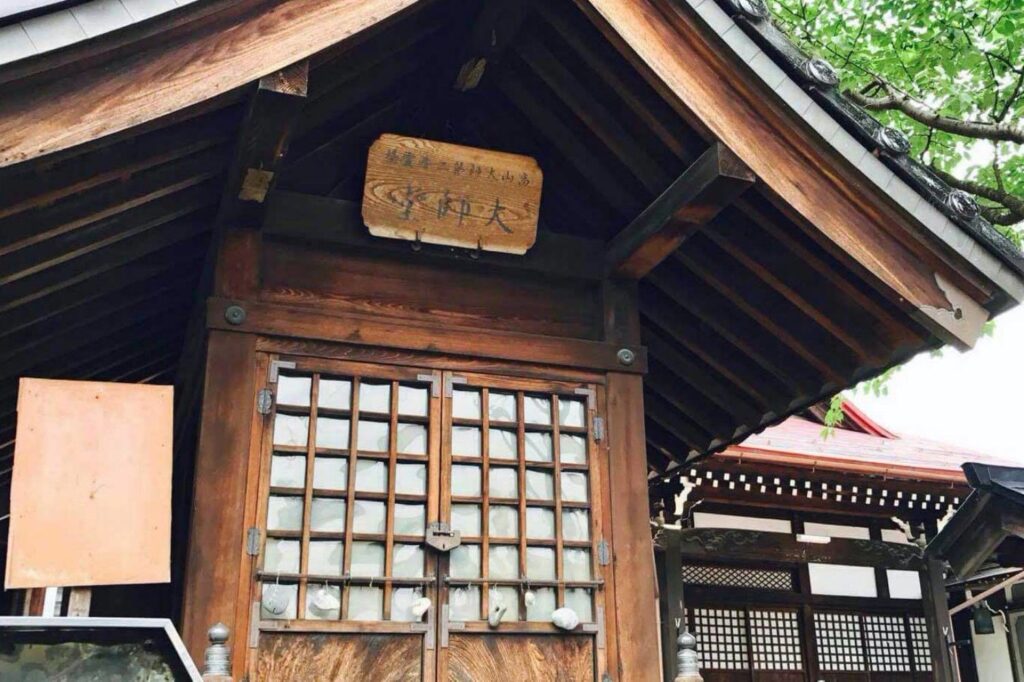
In 1911, twenty-one sacred sites were established in Takayama, transcending religious sects.
This Daishi Hall is the second sacred site, housing the sacred stone known as the “Hole-Opening Stone,” said to bear the imprint of Kobo Daishi’s staff. At Zenkoji Temple, which became one of these sacred sites, the Daishi Hall was built using donations collected from believers and their families.
Legends surrounding Kōbō Daishi tell of his travels across Japan, where he would strike the ground with his staff to bring forth water or hot springs in barren lands, or create saltwater wells in places lacking salt. Stories spread of people regaining sight after drinking the spring water or healing their bodies in the hot springs.
It was said to cure all ailments: eye diseases, gastrointestinal disorders, skin conditions, cuts, burns, ensure safe childbirth, and even aid in calligraphy and tea ceremony.
Those who benefited from the water’s blessings sometimes offered perforated stones, imitating the marks left by his staff, as a token of gratitude.
The belief was that finding a hole in a hard stone, allowing one to see through it, symbolized the fulfillment of wishes. This was seen as an auspicious omen.
Finding a stone with a hole among the pebbles is extremely difficult. The perforated stones symbolize “seeing clearly” (hole passing through = clear vision) and “will passing through” (stone passing through = intentions being conveyed), both connecting to the concept of fulfilling wishes.
At Zenkoji Temple, perforated stones brought by worshippers from across Japan are revered. It is believed that touching the stones or placing them by one’s pillow while sleeping brings blessings for safe childbirth and fertility.
Kaidan-Meguri
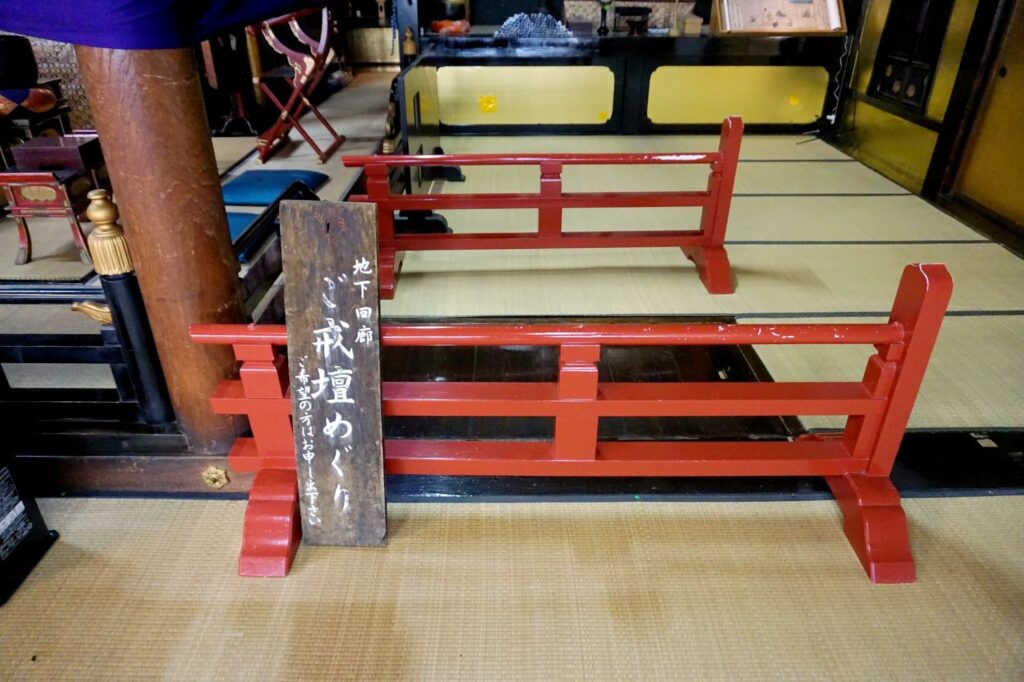
Takayama Zenkoji Temple offers the same Kaidan-meguri ritual as Shinshu Zenkoji Temple.
The Kaidan-meguri at Takayama Zenkoji involves entering an underground corridor from the inner sanctuary of the main hall. Guided only by lantern light, participants circle beneath the secret Buddha statue, the principal object of worship. By touching the “Ojōmae” (a key-shaped object representing the Buddha’s incarnation), they form a connection with the Buddha. This act purifies all evil deeds committed since birth and grants the promise of rebirth in the Pure Land. For this reason, the lock is called the “Key to Washing Away Sins and Reaching Paradise.”
Upon entering the Kaidan-meguri, one gropes through pitch darkness, unable to see even an inch ahead. Eventually, one touches the “Key to Washing Away Sins and Reaching Paradise” suspended directly beneath the principal image and emerges. The first thing one sees is the light streaming in from the exit. Witnessing that faint light before one’s eyes brings a profound sense of relief. One becomes acutely aware of the preciousness of light and the blessing of sight, things often taken for granted.
The darkness within the Kaidan is said to represent a world of indiscriminate equality. In daily life, our eyes are often distracted by superfluous things, causing us to misjudge the essence of things, leading to strife, jealousy, greed, and ultimately suffering. Yet, in the darkness, we are freed from various attachments and focus solely on finding the key. This act is the practice that allows us to enter the world of the Buddha. To all visitors to Zenkōji Temple in Takayama, we urge you to experience the Kaidan-meguri.
※ The interior height is 180 centimeters at its lowest point; taller individuals should take care.
※ The “Key to the Pure Mind and Pure Land” is located on the right wall, at approximately chest height for the average person.
― About Shinsyu Zenkoji ―
Zenkoji Faith
Zenkoji Temple in Nagano Prefecture is a rare temple in Japan, accepting all sects and operating without a parishioner system. As a temple welcoming all people regardless of gender or age, it has long been affectionately called “Zenkoji-san.”
While Zenkoji itself is non-sectarian, within its grounds are the Tendai sect’s “Daikanjin” and the Jodo sect’s “Daibongwan.” Monks from 39 affiliated temples (25 Tendai temples and 14 Jodo temples) jointly protect the main hall. The head priest of the Jōdo sect’s Daihongwan is called the “Zenkoji Priest.” It is a temple where women serve as head priests, welcoming those of court noble descent to this position. It enshrines the principal image of the One Light, Three Buddhas Amida Nyorai, said to be the oldest in Japan.
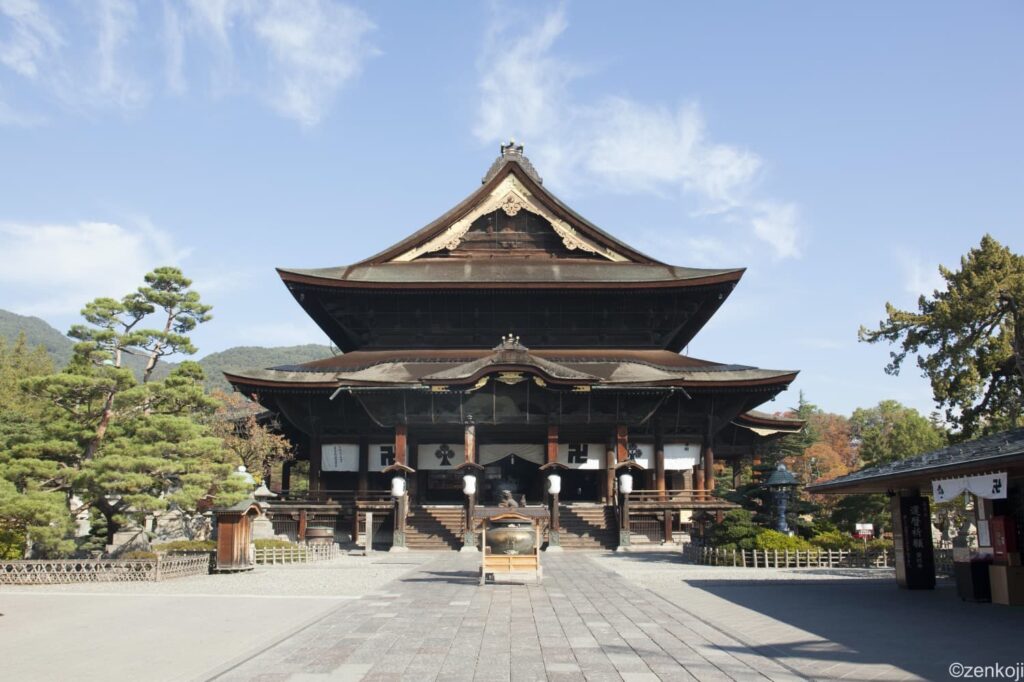
Temple for Women's Relief
Zenkoji Temple is also unusually famous for its role in aiding women.
During the Nara and Heian periods, temples strictly prohibited women’s entry under rigorous precepts. This led to the rise of Kamakura Buddhism, initiated by figures like Shinran, Dogen, and Nichiren, who rebelled against this practice. From this period onward, female devotion to Zenkoji flourished. Originally, Zenkoji was known as a temple that saved women, as evidenced by the story in the “Zenkoji Engi” about curing the illness of a wealthy man’s daughter. During the Kamakura period, Minamoto no Yoritomo’s wife, Hojo Masako, was also a devout believer.
By the Edo period, women made up half of the temple’s visitors, and even today, the majority of worshippers are women.
Gohon-zon
The Amida Nyorai in the single-light, three-deity format is referred to as the Zenkoji Nyorai. This refers to a Buddhist statue where Amida Nyorai, Kannon Bosatsu, and Seishi Bosatsu are enshrined within a single boat-shaped halo.
It is revered as the temple’s absolute secret Buddha, never seen by anyone. However, once every 7 years according to the traditional Japanese calendar, the Maedachi Buddha, a substitute for the secret principal image, is unveiled. Many pilgrims come from all over the country hoping to receive a blessing.